
Part 3. Interpersonal skills in supporting mental health of children (1 ECTS)
Résumé de section
-
CONTENT:
Key elements of quality interpersonal and encountering skills in promotion of MH (Mental Health):
- active listening;
- adaptation to the individual (physical, social, cultural, psychological, spiritual and social factors);
- relevant questions, coordinated verbal and non-verbal communication, influence of emotions on communication, key barriers and facilitators (empathy, mindfulness, assertive approaches…).
Communication with children:- verbal and non-verbal professional communication with children and families
- managing complex situations.
Motivational interview- brief intervention for challenging situation in school environment;
- communication with family in conflict resolution.
Digital communication: specifics of digital communication used by children.OBJECTIVES AND COMPETENCES
- the main objective is to develop interpersonal skills that supports MH of children in school environment;
- the learning unit mainly contributes to the development of the following general and specific competences;
- the development of verbal and non-verbal communication skills and competencies to promote MH;
- the ability to adapt good communication skills with individuals (primary school children and their parents) considering relevant physical, social, cultural, psychological, spiritual and social factors;
- the ability to talk about MH concerns and reduce the stigma associated with mental illness;
- the ability to resolve disorders and manage conflict;
- the ability to work effectively and communicate cooperatively;
- competences in motivational interviewing regarding MH promotion, focusing in work community, children and their families;
- understanding the basic skills of the work community and a work community that supports MH.
INTENDED LEARNING OUTCOMES:
Students:
- understand the importance of communication in promoting MH;
- understand the interactive performance of factors that influence the success of communication;
- apply verbal and nonverbal communication skills, considering individual characteristics, when communicating with children and their parents, and as part of a team;
- know and communicate about MH concerns;
- know how to resolve conflict and apply this in conflict situations;
- know how to communicate to reduce the stigma associated with mental illness.
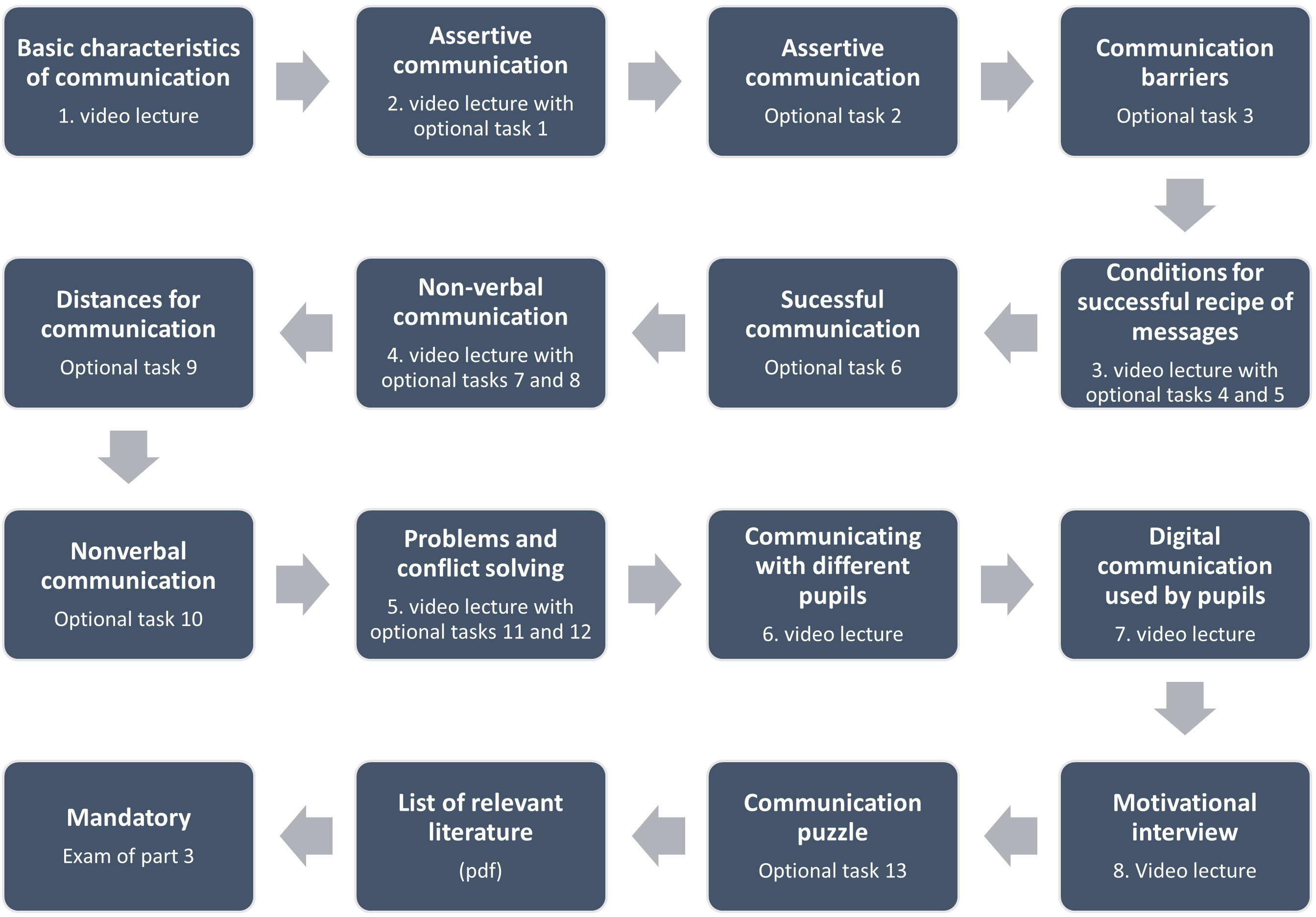
Recomended learning process for Part 3:
-
-
Les étudiants doiventConsulterRecevoir une note
-
Les étudiants doiventConsulterRecevoir une note
-
Les étudiants doiventConsulterRecevoir une note
-
Les étudiants doiventConsulterRecevoir une note
-
Les étudiants doiventConsulterRecevoir une note
-
Les étudiants doiventConsulterRecevoir une note
-
Les étudiants doiventConsulterRecevoir une note
-
Les étudiants doiventConsulterRecevoir une note
-
Les étudiants doiventConsulter
-
-
-
-
Les étudiants doiventConsulterRecevoir une note
-